


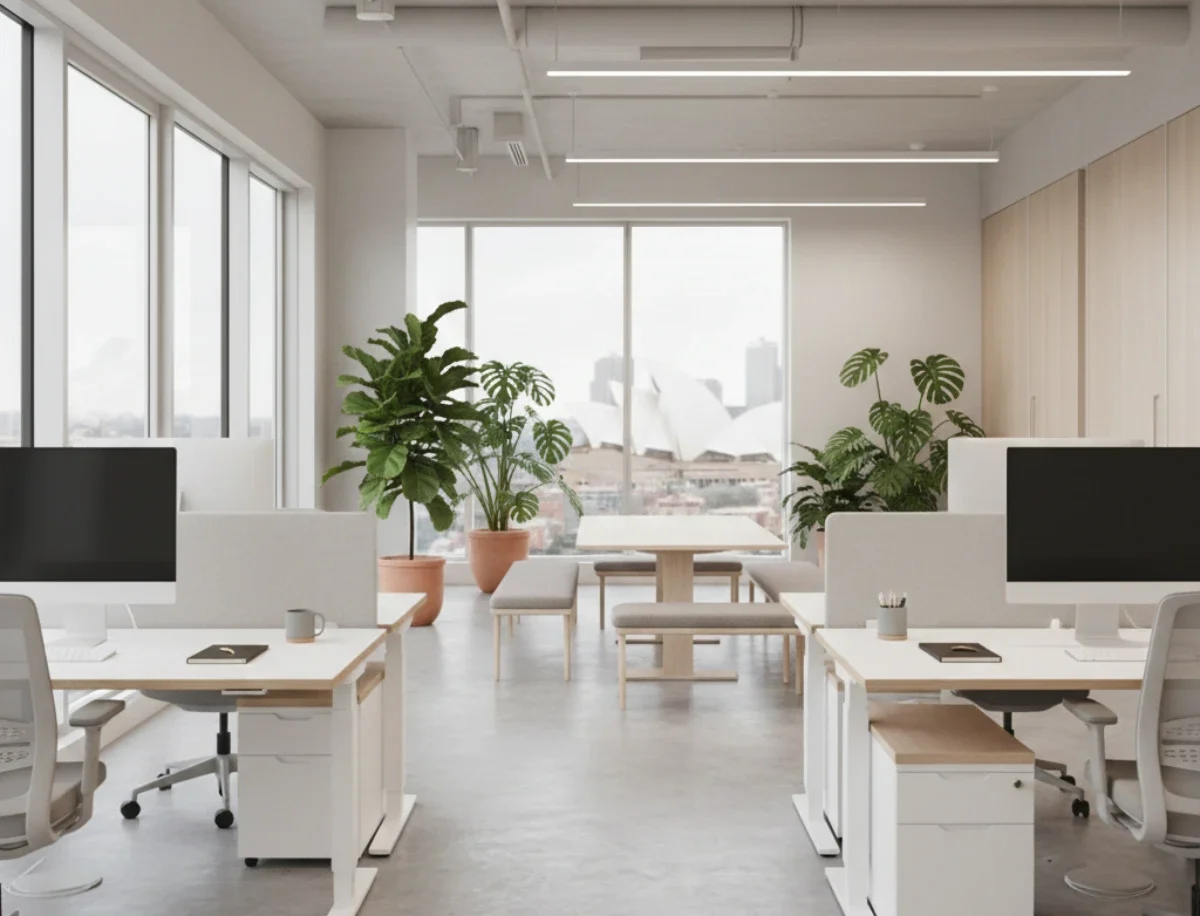
Workplaces in Australia are changing. More companies are moving away from cluttered, overstimulating offices and embracing minimalist office interiors that prioritise focus, functionality, and wellbeing.
Minimalism is not just an aesthetic — it is a business strategy that can improve productivity, reduce costs, and create a calmer work environment.
This article explains how minimalist office design works in Australia, why it boosts productivity, and how much it really costs in 2026 — with practical steps Australian companies can implement.
Quick Overview (Snapshot Summary)
- Minimalist offices reduce visual clutter and mental distraction
- Open, light-filled spaces improve focus and collaboration
- Quality furniture lasts longer, reducing long-term costs
- Natural materials and greenery support employee wellbeing
- Smart layouts can make small offices feel much larger
Want to redesign your office without wasting money? Keep reading.
1) What Is Minimalist Office Design?
Minimalist interiors follow a simple rule:
Less is more — but better is best.
In an Australian business context, this usually means:
- Neutral colour palettes (white, beige, grey, timber tones)
- Open layouts instead of crowded partitions
- Multi-functional furniture
- Natural light and indoor plants
- Clear, organised workstations
The Australian Institute of Architects highlights that modern workplaces are moving toward simplicity, daylight, and flexible spaces that adapt to hybrid work.
Source: https://www.architecture.com.au
2) Why Minimalist Offices Improve Productivity
Studies consistently show that visual clutter increases stress and reduces concentration.
Minimalist offices help employees:
- Think more clearly
- Feel less overwhelmed
- Collaborate more easily
- Stay organised
- Work more efficiently
The CSIRO’s research on workplace design shows that natural light, greenery, and open layouts can improve employee wellbeing and cognitive performance.
Source: https://www.csiro.au
Pro Tip: If your office feels chaotic, your team probably feels chaotic too.
3) Key Elements of Minimalist Office Interiors
A. Neutral Colour Palette
Stick to:
- White
- Soft grey
- Natural timber
- Light beige
These colours make spaces feel larger and calmer.
B. Quality Over Quantity Furniture
Instead of cheap desks:
- Choose durable standing desks
- Use ergonomic chairs
- Invest in long-lasting meeting tables
C. Smart Storage Solutions
Minimalism does not mean “no storage” — it means hidden storage:
- Built-in cabinets
- Wall shelving
- Filing systems inside desks
D. Biophilic Design (Nature Inside)
Indoor plants improve air quality and mood.
The Green Building Council of Australia (GBCA) supports nature-integrated office design for sustainability and wellbeing.
Source: https://www.gbca.org.au
4) How Minimalist Design Reduces Costs for Companies
Minimalism can actually save money over time.
Short-term savings:
- Fewer decorations
- Less furniture needed
- Lower renovation complexity
Long-term savings:
- Better-quality furniture lasts longer
- Lower energy use from natural light
- Less need for frequent redesigns
Sustainability Victoria notes that well-designed, energy-efficient offices reduce power bills and maintenance costs.
Source: https://www.sustainability.vic.gov.au
5) Minimalist Layouts That Work for Australian Offices
Option 1 — Open Plan
Best for:
- Creative teams
- Startups
- Collaboration-heavy workplaces
Option 2 — Hybrid Zones
Mix of:
- Quiet zones
- Meeting spaces
- Open collaboration areas
Option 3 — Hot-Desking
Ideal for hybrid teams where not everyone is in the office daily.
6) Quick Guide — How to Create a Minimalist Office (Step-by-Step)
Common challenges companies face:
- Too much furniture
- Poor lighting
- No clear layout
- Mismatched design styles
How to solve it:
- Declutter first — remove unused items
- Repaint walls in neutral tones
- Upgrade lighting to warm LED panels
- Add plants instead of artwork overload
- Choose simple, ergonomic furniture
- Design clear pathways and work zones
Why this works:
A clean, structured space supports clear thinking and higher productivity.
7) Interactive Quiz — Is Your Office Ready for Minimalism?
Q1: How cluttered is your workspace?
A. Very organised
B. Some clutter
C. Chaotic
Q2: Do employees have access to natural light?
A. Yes, lots
B. Some
C. Almost none
Q3: Is your furniture modern and ergonomic?
A. Mostly
B. Mixed
C. Mostly outdated
Results:
- Mostly A → You are already close to minimalist design
- Mostly B → You need a partial redesign
- Mostly C → A full minimalist makeover is recommended
8) FAQs — Minimalist Office Interiors Australia
Q1: Is minimalist design suitable for all businesses?
Yes — from law firms to tech startups, minimalism can be adapted to any industry.
Q2: Does minimalist design mean boring?
No. Minimalist spaces can be stylish, professional, and inspiring.
Q3: How much does it cost to redesign an office?
Costs vary widely:
- Small office: $10,000–$40,000
- Medium office: $50,000–$150,000
- Large office: $200,000+
Q4: Do minimalist offices improve employee wellbeing?
Yes — especially when combined with natural light and plants.
Conclusion
Minimalist office interiors for companies in Australia are more than a trend — they are a practical way to enhance productivity, reduce stress, and lower long-term costs. By focusing on clean layouts, neutral colours, quality furniture, and natural elements, businesses can create workspaces that feel professional, modern, and supportive of employee wellbeing. Whether you are redesigning a small startup office or a large corporate headquarters, adopting minimalist principles helps Australian companies build efficient, sustainable, and inspiring workplaces that perform better in 2026 and beyond.
Disclaimer
This article is for general informational purposes only. Office design costs, benefits, and results vary depending on location, industry, and building constraints. Consult a qualified interior designer, architect, or workplace consultant before undertaking major renovations.


Leave a Reply