


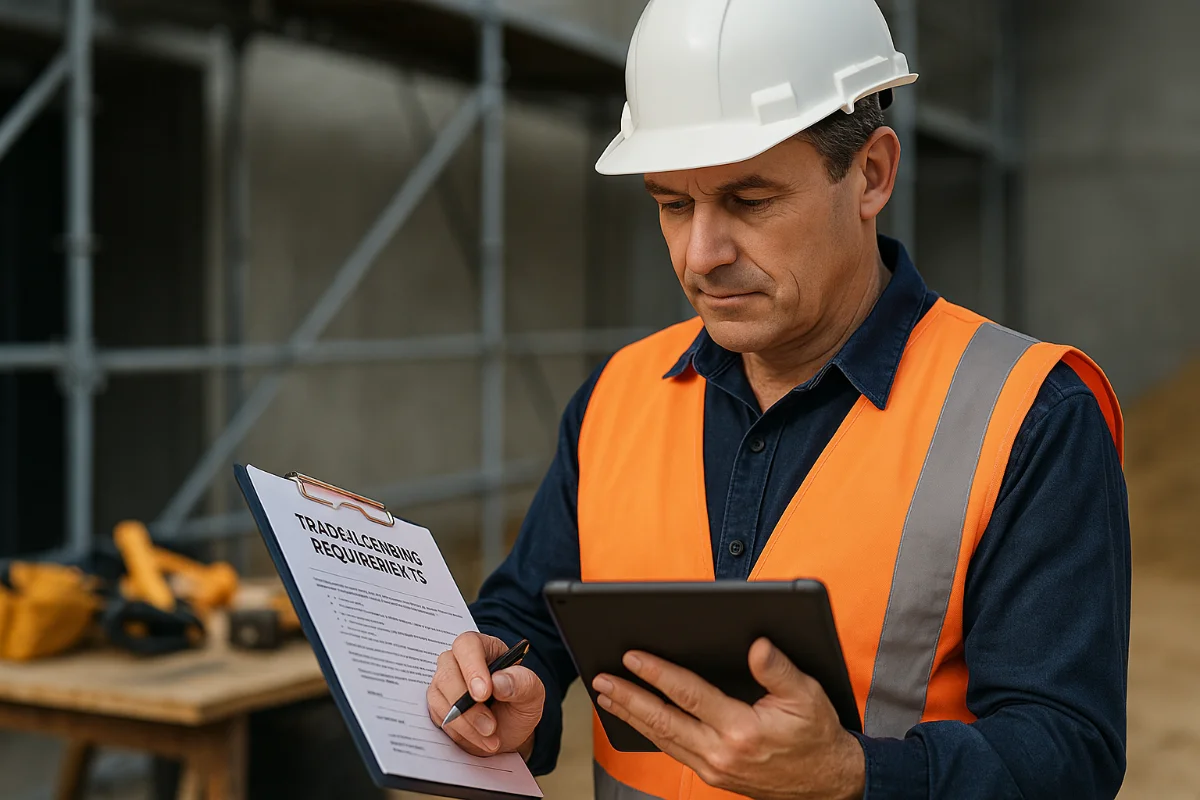
Whether you’re a seasoned tradesperson or just starting out, one thing’s certain — Australia takes trade licensing seriously. From electricians to builders, plumbers to HVAC technicians, compliance with licensing laws isn’t just red tape — it’s a safeguard for your clients, your business, and your professional reputation.
In this comprehensive 2025 guide to trade licensing requirements in Australia, we’ll explain how licenses differ by trade and state, what you need to qualify, and how to stay compliant under the Building Code of Australia (BCA) and other regulatory frameworks.
Let’s make sense of the rules so you can focus on what you do best — your trade.
Quick Overview: Snapshot Summary
At a Glance
- All specialist trades in Australia require proper licensing and insurance before commencing work.
- Licensing requirements differ between states and territories.
- Most trades require qualifications, work experience, and ongoing compliance checks.
- In 2025, digital verification systems make license checks easier than ever.
Want to ensure your trade license is compliant? Keep reading for the full breakdown.
1. Why Trade Licensing Matters in Australia
Licensing ensures that only qualified professionals carry out high-risk work — protecting public safety and consumer trust.
Key Reasons
- Legal compliance: Performing unlicensed work can attract heavy fines.
- Safety assurance: Properly trained tradespeople reduce on-site risks.
- Consumer confidence: Licensed professionals are trusted and insurable.
- Market access: You can only legally advertise or contract if licensed.
Did You Know?
In 2024, over 5,000 fines were issued nationwide for unlicensed trade work, with penalties up to $40,000 per offence (source: ABCB.gov.au).
2. Trade Licensing Overview: Federal vs State Systems
There’s no single national trade license — each state and territory regulates its own system. However, most follow similar frameworks.
| State / Territory | Regulatory Body | Licensing Focus Areas |
|---|---|---|
| New South Wales (NSW) | NSW Fair Trading | Building, electrical, plumbing, gasfitting |
| Victoria (VIC) | Victorian Building Authority (VBA) | Building, plumbing, refrigeration |
| Queensland (QLD) | Queensland Building and Construction Commission (QBCC) | Building, waterproofing, fire protection |
| South Australia (SA) | Consumer and Business Services (CBS) | Building, electrical, gas, demolition |
| Western Australia (WA) | Building and Energy WA | Electrical, plumbing, gas, restricted trades |
| Tasmania (TAS) | Consumer, Building and Occupational Services (CBOS) | Building, plumbing, gasfitting |
| ACT | Access Canberra | Building, plumbing, electrical |
| Northern Territory (NT) | Building Practitioners Board | Building, plumbing, gas, electricians |
Pro Tip Box
If you work across state borders, you may need multiple licenses — or recognition through the Automatic Mutual Recognition Scheme (AMR) introduced nationally in 2021.
3. Core Licensing Requirements for Major Trades (2025)
1. Building and Construction
- Required by: All states and territories.
- Qualification: Certificate IV in Building and Construction (CPC40120) or higher.
- Insurance: Home warranty insurance (for residential work).
- Additional: Proof of experience, financial assessment, and police check.
2. Electrical
- Required by: Nationwide.
- Qualification: Certificate III in Electrotechnology Electrician.
- Regulator: State energy safety authority.
- Ongoing requirement: Annual safety and calibration checks.
3. Plumbing and Gasfitting
- Qualification: Certificate III in Plumbing (CPC32420).
- License categories: Water supply, sanitary, gas, roofing, drainage.
- Regulator example: VBA (VIC), QBCC (QLD).
- Insurance: Mandatory for public liability and compliance certificates.
4. HVAC (Refrigeration & Air Conditioning)
- License type: Refrigerant Handling Licence (RHL).
- Regulator: Australian Refrigeration Council (ARC).
- Requirement: Certificate III in Air Conditioning and Refrigeration (UEE32220).
- Renewal: Every 3 years.
5. Asbestos Removal
- License type: Class A or Class B asbestos removal licence.
- Regulator: WorkSafe or SafeWork (state-based).
- Training: National unit CPCCDE3015 “Remove friable asbestos.”
4. How to Apply for a Trade Licence
Step-by-Step Process
- Check your trade classification: Confirm the category under your state regulator.
- Meet qualification requirements: TAFE or RTO certification.
- Gain work experience: Usually 2–4 years under supervision.
- Prepare documents:
- Qualifications and transcripts
- ID and right-to-work proof
- Business name registration (if applicable)
- Police check and insurance evidence
- Submit application: Online via your state’s licensing portal.
- Pay fees: Typically $200–$800 depending on trade and class.
- Await approval: Usually 2–6 weeks for initial applications.
Pro Tip Box
Always use your state’s official portal — fake “licensing service” websites are increasing in 2025.
5. Renewal and Ongoing Compliance
Licences aren’t “set and forget” — they require periodic renewal.
Typical Renewal Schedule
| Trade | Renewal Frequency | Average Fee (AUD) |
|---|---|---|
| Electrical | Every 3 years | $250–$400 |
| Building | 1–3 years | $300–$500 |
| Plumbing | 1 year | $200–$350 |
| HVAC | 3 years | $280 |
| Asbestos | 5 years | $400–$700 |
Ongoing Requirements
- Continuing professional development (CPD)
- Compliance audits or site inspections
- Proof of insurance and tax compliance
Did You Know?
Failing to renew a license can result in automatic suspension — and invalid insurance coverage.
6. Insurance and Legal Obligations for Tradespeople
Licensed trades must maintain valid insurance to operate legally.
Key Policies
- Public liability insurance: Covers third-party injury or property damage.
- Workers compensation: Mandatory if you employ staff.
- Professional indemnity: For design or advisory services.
- Tools and vehicle insurance: Optional but essential for mobile trades.
Pro Tip Box
Always keep digital proof of coverage — many 2025 audits are fully online.
7. Digital Licensing and Verification in 2025
Australia is shifting to digital-first verification.
Digital Innovations
- Service NSW, Service VIC, and MyGovID apps now store digital trade cards.
- QR codes allow instant client verification.
- AMR (Automatic Mutual Recognition) makes interstate trade easier.
Did You Know?
In 2025, over 80 % of trade licence verifications are completed online by consumers before hiring.
Reference: business.gov.au/licences.
Quick Guide: Compliance Checklist for 2025
Intro:
Here’s your rapid 5-point compliance check.
Common Challenges:
- Missing renewal notices.
- Working interstate without valid recognition.
- Outdated insurance details.
- Misclassifying subcontractors.
How to Solve It:
- Set digital reminders for renewals.
- Confirm AMR eligibility before cross-border jobs.
- Keep all policy documents cloud-backed.
- Recheck your trade classification yearly.
- Train your staff on safety and reporting duties.
Why It Works:
Compliance keeps your business legal, insurable, and reputation-strong.
Interactive Quiz: Is Your Trade Licence 2025-Ready?
| Question | A) Yes | B) Somewhat | C) Not Yet |
|---|---|---|---|
| 1. My licence is current and valid for my state. | 3 | 2 | 1 |
| 2. I’ve renewed my insurance and stored proof. | 3 | 2 | 1 |
| 3. I know which regulator governs my trade. | 3 | 2 | 1 |
| 4. I understand AMR and how it affects me. | 3 | 2 | 1 |
| 5. My qualifications meet 2025 standards. | 3 | 2 | 1 |
Results:
- 13–15: Fully compliant — great job!
- 9–12: You’re close — check renewals and AMR.
- ≤8: Review this guide and contact your local authority ASAP.
FAQs
Q1: What happens if I work without a licence?
You risk fines up to $40,000 and loss of insurance coverage. Repeat offences can result in prosecution.
Q2: Can I use my interstate licence automatically?
Yes, under Automatic Mutual Recognition, provided your trade and state participate (check via business.gov.au).
Q3: Do I need a licence if I subcontract under another builder?
Usually yes — unless your role is minor and fully supervised under the principal licence.
Q4: How do I check if a tradie is licensed?
Use state verification portals like Service NSW or VBA License Check.
Q5: Can I lose my licence?
Yes — for non-compliance, unsafe practices, or fraud. Regulators can suspend or permanently revoke licences.
Conclusion
Trade licensing in Australia isn’t just bureaucracy — it’s professionalism.
In 2025, licensing frameworks are evolving fast, with stricter digital checks and greater accountability. Whether you’re a plumber in Sydney or an HVAC tech in Perth, maintaining compliance ensures trust, safety, and success.
Think of your licence as your passport to opportunity — protect it, renew it, and let it speak for your skill.
Disclaimer
This article provides general information only and is not legal or financial advice. Always check your state’s licensing authority for the most accurate and up-to-date requirements.


Leave a Reply